


The saxophone is a single-reed aerophone that features a unique hybrid construction. Although formally belonging to the woodwind family due to its sound production system (it uses a cane reed attached to a mouthpiece identical to that of the clarinet), its body consists of a widely conical bore tube constructed from metal, typically brass. The sound originates from the vibration of the reed against the mouthpiece opening, driven by the musician's breath.
Acoustically, its accentuated conical profile gives it the properties of an open tube. This allows it to overblow at the octave, unlike the clarinet, simplifying the key mechanism and fingering in the transition between the low and high registers. The resulting timbre is extremely flexible, blending the typical technical agility of woodwinds with the power and acoustic projection of brass.
Historically, it is one of the few globally used instruments with a documented singular inventor. It was patented in 1846 by the Belgian builder Adolphe Sax, in Paris. Its primary objective was to create the perfect acoustic bridge between orchestral sections to balance French military bands, having immediately developed a complete family of instruments.
Teachers
Courses with this instrument

Carlos Ramalho
Saxophone, Ensemble Class
Born in Crestuma – V.N. de Gaia, he completed his musical studies at the Conservatório de Música do Porto (saxophone class of Prof. Francisco Ferreira) and at the University of Évora (saxophone class of Prof. José Massarrão). He worked with renowned saxophonists such as Claude Delangle, Jean-Yves Fourmeau, Stéphane Laporte, Arno Bornkamp, Vincent David, among others.
He participated in several recordings and concerts broadcast live by Antena 2 and RTP. He joined the European Union Youth Wind Orchestra and the National Templários Wind Orchestra. He performed as a soloist with the Portuguese Symphonic Band and the Municipal Band of A Coruña. He was a co-founding member of the Porto Saxophone Quartet, the Portuguese Symphonic Band, the Ensemble Contemporaneus, and a member of the Algarve Wind Orchestra. With these ensembles, he premiered works by various composers and participated in several recording editions.
In terms of pedagogy, he led several advanced training courses in Portugal and Spain. He taught at the schools of Academia de Música de Lagos, at the Conservatório de VRSA, and at the Conservatório de Música Lagoa - Artis XXI, among others. He is currently a saxophone teacher at the Conservatório de Música de Loulé – Francisco Rosado.
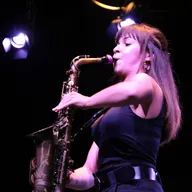
Marina Ferreira is a native of Viseu. She began her musical studies in a Philharmonic Band in her municipality, having subsequently attended the Conservatório de Música de Seia.
and the Conservatório de Música de Viseu, where she completed the 8th grade in 2012. She holds a Bachelor's degree in Music, specializing in Performance – Saxophone, and a Master's degree in Music Education from the University of Évora. In 2025, she also completed a Master's degree in Music Therapy from the Esneca Business School, deepening her interest in music as a tool for promoting well-being.
Throughout her journey, she participated in workshops, masterclasses, competitions, and wind orchestra internships, coming into contact with national and international musicians. In the pedagogical field, they taught saxophone at various institutions, including ÁlamosArt – Academia de Música e Artes dos Álamos, the Conservatório Regional de Artes do Montijo, the Escola de Música da Sociedade Antiga Filarmónica Montemorense “Carlista”, and the Academia de Música de Portimão. She was also a saxophone instructor for wind orchestra internships in Évora and Lagoa.
Currently, she holds teaching positions at the Conservatório de Música e Artes de Lagos, the Conservatório de Artes de Lagoa, and the Conservatório de Música de Loulé – Francisco Rosado, and is also a member of the Orquestra Ligeira de Lagos.