

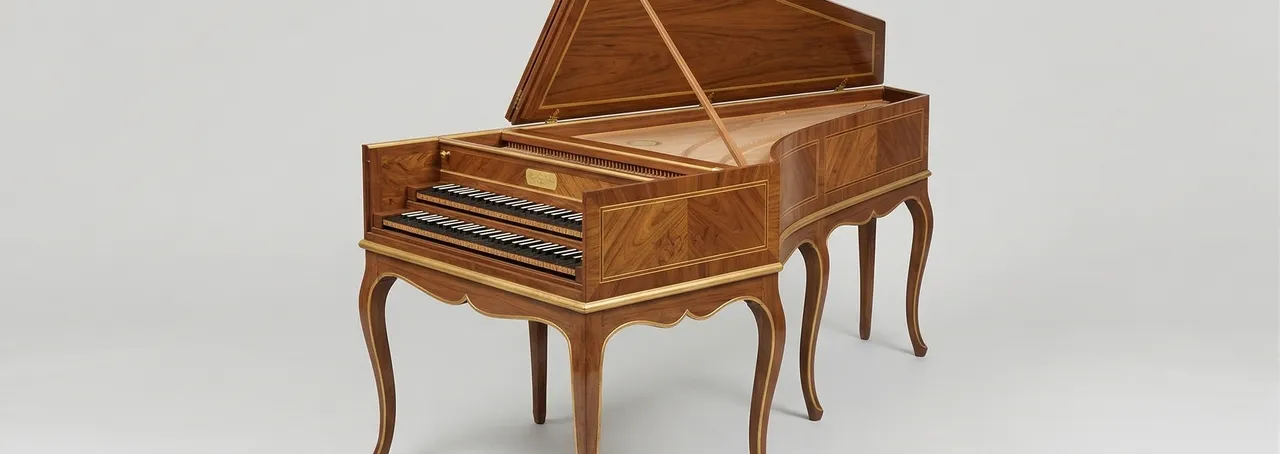
The harpsichord is a keyboard chordophone, widely used between the 16th and 18th centuries, being one of the predecessors of the piano. Its morphology resembles that of a grand piano, but with a significantly lighter internal structure and one or two manuals (keyboards).
The sound of the harpsichord is produced by a plucking mechanism. When a key is pressed, a small plectrum (traditionally made of raven quill, or currently of plastic) is raised and "plucks" the corresponding string before returning to its original position.
Acoustically, this mechanism produces a characteristic sound: incisive, brilliant, rich in harmonics, and with a rapid decay. The main acoustic limitation of the harpsichord lies in its inability to alter the intensity of the sound (dynamics) through the force applied to the key; the volume is essentially fixed.
Historically, the harpsichord derived from the psaltery, acquiring a keyboard. It was the dominant keyboard instrument in the Baroque period, essential both as a soloist (in works by Bach or Scarlatti) and in the role of "basso continuo" to accompany orchestras and singers. The harpsichord re-emerged in the 20th century with the historically informed performance movement.
Teachers
Courses with this instrument
António Hipólito
Harpsichord, Accompaniment
António Hipólito, organist, harpsichordist, and pianist, obtained a degree in Harpsichord and has demonstrated a continuous interest in instruments from an early age.
He leads a career marked by the performance of works by numerous composers such as J. S. Bach, Manuel Rodrigues de Coelho, Carlos Seixas, João Domingues Bomtempo, François Couperin, J. P. Rameau, Alessandro Scarlatti, G. F. Händel, John Keeble, John Stanley, D. Buxtehude, C. P. E. Bach, among other composers.
He has performed in historical venues such as the Monastery of Sta. Cruz in Coimbra and the Cathedral of Castelo Branco, Águeda, Faro, Lisbon, Bragança, Braga, Aveiro, Idanha-a-Nova, Idanha-a-Velha, Cabeceiras de Basto, Lorvão, Cantanhede, and Italy, Bologna.
Solo concerts and partnerships with INATEL, with the Municipalities of Cantanhede and Cabeceiras de Basto, and with the Polytechnic Institute of Castelo Branco have revealed his dedication to early music.
As a tenor, continuist, and organist, he was a member of the Ançã-ble choir, a founding member of Trio Scherzo, and a harpsichordist in the Orquestra Ibérica da Música Antiga Associação Cultural, an orchestra he accompanied in 2026 in J. S. Bach's St. Matthew Passion.
In 2024, he obtained a Master's degree in Harpsichord Teaching, supervised by Prof. João Janeiro.
He is currently serving as a Piano teacher at the Conservatório Regional do Algarve Maria Campina and as an Accompanist Harpsichordist at the Conservatório de Música de Loulé - Francisco Rosado.
Catarina Lemos e Melo began her musical studies at the Academia de Música de Santa Cecília. She graduated from the Escola Superior de Música de Lisboa and later completed her Master's in Performance at the Schola Cantorum Basiliensis under the guidance of Andrea Marcon.
She develops her artistic activity as a performer, regularly appearing as a soloist. She regularly collaborates with vocal and instrumental ensembles dedicated to historically informed performance, integrating early music projects and interdisciplinary productions focused on Renaissance and Baroque repertoire.
She performed in renowned venues and spaces such as the Centro Cultural de Belém, Palácio Nacional da Ajuda, Palácio Foz, Palácio Nacional de Mafra, Casa-Museu Anastácio Gonçalves and the Fundação Calouste Gulbenkian. She also performed in projects with the Orquestra de Câmara Portuguesa and the Orquestra Metropolitana de Lisboa.
She is a founding member of the ensemble Gli Accentii, with which she performs regularly in concert, both in Portugal and abroad. She organized a concert series at Casa-Museu Anastácio Gonçalves during the 2019/2020 season. With Gli Accenti, she also performed at various festivals such as InMusica, Verão de Queluz, Noites de Queluz, Med Classic, Divam, Arte Larga, and Festival Setecentista.
Currently, she is a harpsichord teacher at the Conservatório de Música de Loulé – Francisco Rosado.