

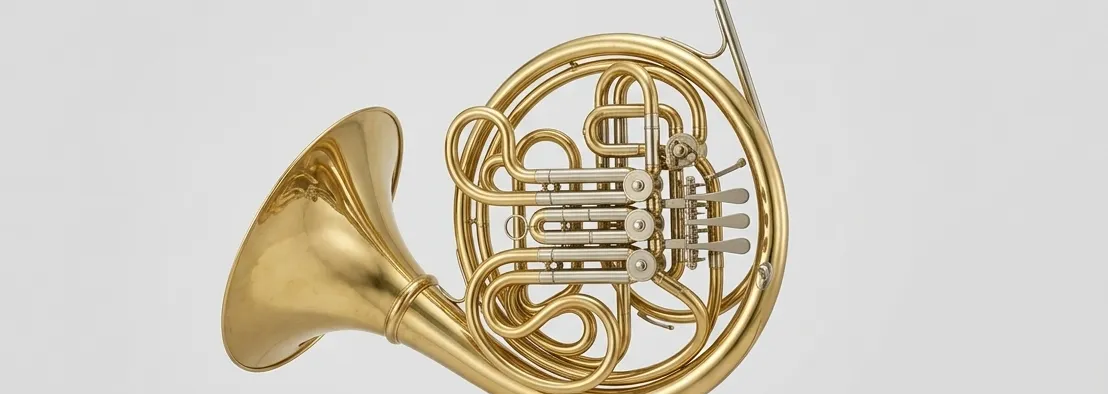
The horn is a brass aerophone (made of brass) with a mouthpiece, whose complex morphology distinguishes it from other wind families. It is characterized by a very long tube (often exceeding three meters, in the double horn in F/B-flat), with a predominantly conical bore, which coils upon itself in a circular shape, ending in a considerably wide bell projected backwards. The sound results from the vibration of the instrumentalist's lips against a small funnel-shaped mouthpiece.
Acoustically, the conical bore of the tube and the deep mouthpiece favor the production of harmonics, resulting in a timbre that is simultaneously dark, enveloping, and capable of great sonic heroism. The traditional technique involves inserting the right hand into the bell (the bouché or stopped horn technique), which allows for slight pitch correction or drastic alteration of the timbre.
Historically, the modern horn descends from the hunting horn (cor de chasse). During the Classical period (as attested by Mozart's concertos), the "natural horn" was played, without valves, altering the notes by adding different lengths of extra tubing (crooks) and the position of the hand in the bell. The invention of the valve in the early 19th century revolutionized the instrument, allowing it full chromaticism and solidifying its central position in the symphony orchestra.