

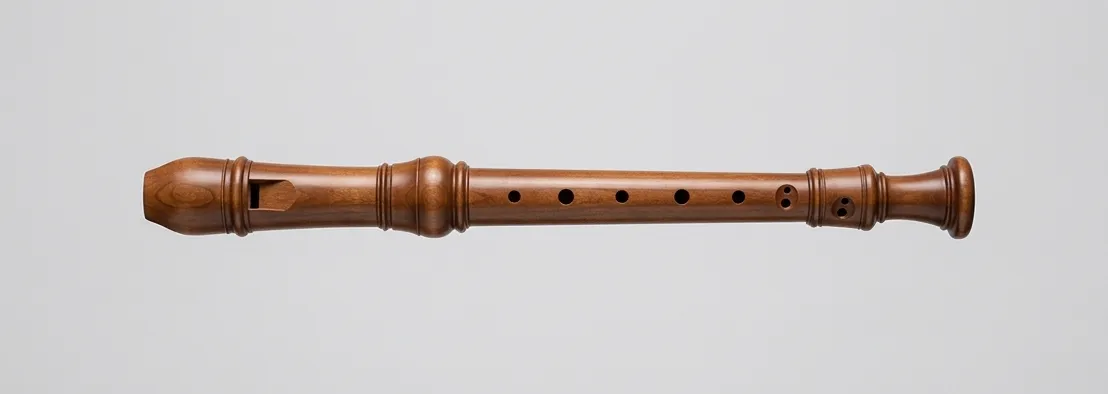
The recorder (or sweet flute) is an aerophone whose sound is produced by a whistle system (fipple) coupled to a bore tube, mostly slightly inverse conical (narrower at the lower end). Morphologically, it is constructed of wood and typically articulates into three joints: the head (which contains the mouthpiece and the windway), the body (with the finger holes), and the foot. The sound results from the compression of breath through a narrow channel, striking against a sharp edge (the labium) which divides the airflow and causes acoustic oscillation inside the tube.
Acoustically, it behaves like an open tube, producing a complete harmonic series. The tuning of the notes is altered by opening and closing eight finger holes (seven in the front and one in the back for the thumb), frequently using "crossed" or forked fingerings (cross-fingering) to achieve chromaticism.
Historically, the recorder reached its heyday during the Renaissance and Baroque periods, when a complete family (from sopranino to contrabass) was developed for the performance of consort music. Its decline at the end of the 18th century was due to its inability to rival the dynamic power and sound projection of the emerging transverse flute. The instrument re-emerged in the 20th century, driven by the historically informed performance movement and music pedagogy (notably by the Orff method).
Teachers
Courses with this instrument

Began her musical studies in Loulé, as a student of Professor Francisco Rosado. Completed her degree in Recorder at ESML and her Master's degree in performance at Lemmensinstituut – Leuven. She completed her Master's degree in Music Education at ESML.
Performed dozens of concerts in various parts of the country, in various chamber ensembles, and as a soloist with the baroque orchestras Concerto Ibérico and Orquestra D’Aquém Mar. Performed concerts in several European countries, namely Belgium, the Netherlands, Italy, Spain, and Austria. She recorded an album with the duo Flor de Sal.
Taught at the international Recorder courses in Lyme Regis (United Kingdom), at the I and II Recorder Consort Workshops in Almeida and Seia, and is a founding teacher of the Early Music Summer Camp, integrated into the Castelo Novo Festival. Provided musical direction for the Ao Luar Teatro company.
Won the 1st and 2nd Prizes in International Competitions in Belgium and Germany.
Maintains a regular musical activity in Portugal. Is the Artistic Director of the Encontros de Música Antiga de Loulé Francisco Rosado; vice-president of Flautística – Associação de Flautas de Bisel do Algarve, directs the Ensemble de Flautas de Loulé and teaches Recorder at CML-FR.