


The Portuguese guitar is a plucked string instrument distinguished by its pear-shaped soundbox and its unique fan-shaped metal tuning mechanism, which replaces traditional tuning pegs. Its structure consists of twelve steel strings, arranged in six double courses (pairs of strings tuned in unison or at the octave).
Acoustically, the sound is produced by plucking the strings using artificial nails (fingerpicks) adapted to the player's thumb and index finger. This attack technique, combined with the tension of the steel strings and the construction of the body, results in an unmistakable timbre: metallic, bright, resonant, and deeply expressive. The double courses substantially enrich the projection of the upper harmonics.
Historically, contrary to what the name suggests, it does not descend from the classical guitar, but rather from the family of European Renaissance citterns. Its direct evolution in Portugal, between the 18th and 19th centuries, was strongly influenced by the English cittern. It developed into two main models (Lisbon and Coimbra), becoming the solo instrument par excellence, intimately and inseparably linked to the interpretation of Fado.
Teachers
Courses with this instrument
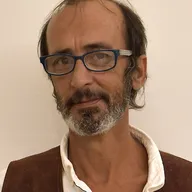
José Alegre
Portuguese Guitar, Ensemble Class
José Alegre was born in Lisbon in 1963 and began his musical journey as a self-taught musician in his early adolescence. He considers Music an open world without borders, dividing his practice among various instruments and his interests across areas as diverse as historical music, rock, traditional Portuguese music, and many other ethnic forms he encounters, on a path full of affections and unexpected ramifications.
In 1997, he completed his classical guitar studies at the Conservatório Regional do Algarve in the class of Professor Eudoro Grade. He began playing the Portuguese guitar in 2002 with guitarist Miguel Drago, and from 2005 onwards, he regularly worked with guitarist and composer Pedro Caldeira Cabral. In September 2012, he completed the first bachelor's degree in Portuguese guitar, mentored by musician and composer Custódio Castelo, at the Escola Superior de Artes Aplicadas in Castelo Branco. In September 2017, at the same institution, he completed a Master's degree in instrument and chamber music teaching. Currently, he teaches Portuguese guitar and ensemble music at the Conservatório de Música de Loulé, while simultaneously developing a regular activity in various projects related to world music.