The Expansion of the Educational Offer at the Conservatório de Música de Loulé - Francisco Rosado and the Impact of the Introduction of the Pipe Organ and the Harp in the Artistic Education Network South of Lisbon
Index /* Main Container to isolate CSS */ #cml-article-wrapper { font-family: 'Segoe UI', Roboto, Helvetica, Arial, sans-serif; line-height: 1.6; color: #333; background-color: #ffffff; max-width: 100%; /* Adapts to Elementor container */ margin: 0 auto; padding: 20px; box-sizing: ...
Index
1. Institutional Framework and Growth Dynamics
The Conservatório de Música de Loulé - Francisco Rosado (CML-FR), a specialized artistic education institution integrated into the public network of the Ministry of Education under code 806370, establishes itself in the national educational landscape as a case study of consolidated growth and strategic management of its educational offerings.1 Housed in Solar da Música Nova, a rehabilitated building of significant heritage that symbolizes the convergence between historical memory and pedagogical contemporaneity2, the Conservatory has, in just seven full academic years of operation, redefined the paradigms of access to music education in the Algarve region.
The genesis and evolution of CML-FR cannot be dissociated from a philosophy of proactive management. Contrary to the traditional tendency to size the educational offer strictly according to existing demand, the Conservatory adopted a stance of "demand-inducing offer".
With just over 320 students enrolled to date and already offering 23 distinct training programs — covering 21 musical instruments, singing, and the composition course — the school has reached a point of virtuous saturation: practically all instruments have full schedules with their respective teachers.4 This indicator reveals that the educational community not only absorbs the existing offer but demonstrates a cultural elasticity and appetite that validates the introduction of new instrumental variants.
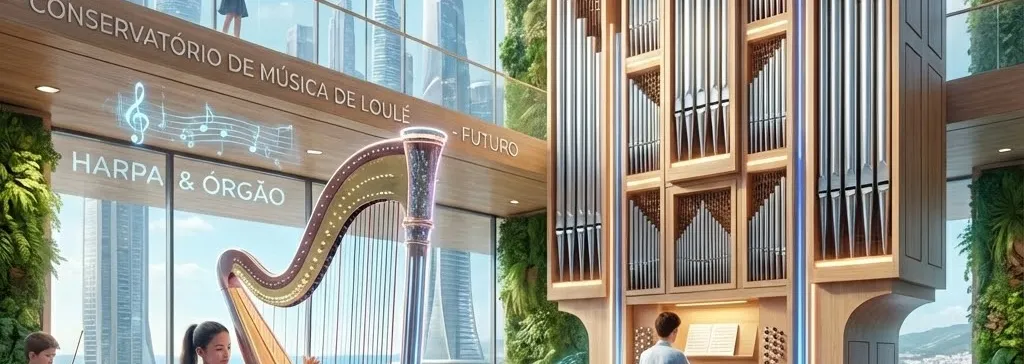
The strategy for the provision of new offers to "spark interest"4 underpins the present intention to broaden the educational offering to the Pipe Organ and Harp. These additions do not represent mere numerical increments, but rather qualitative leaps in the institution's artistic identity, allowing it to address symphonic and chamber repertoires of high complexity, filling structural gaps in the educational network south of Lisbon.
1.1 The Building as Third Educator: Solar da Música Nova and its Expansion
The physical infrastructure of CML-FR plays a central pedagogical role. The rehabilitation project of Solar da Música Nova, designed by architect Victor Mestre3, it was not just a restoration project, but an act of urban reinvention that integrated the school into the so-called "Cultural Quarter" of Loulé.6 Contemporary architecture, in dialogue with the 18th-century pre-existence, creates a learning environment that values aesthetics and acoustics.7
The relevance of Victor Mestre extends beyond the school walls. His intervention in the Igreja Matriz de São Clemente, a national monument and future home of the Symphonic Organ, establishes a spatial and conceptual continuity between the place of teaching (the Conservatory) and the place of performance (the Church).2 This physical connection reinforces the school's mission to extend beyond the classroom, transforming the city into an extended educational campus, where built heritage and intangible heritage (music) merge into a total educational experience.
In parallel, and as a consequence of its success, the current building of the Conservatory proved to be of insufficient dimensions for the demand. Therefore, in order to meet the demand, on the one hand, and to be able to increase the educational offerings available (such as the pipe organ and the harp, among other potential ones), on the other hand, the municipality committed to creating from scratch an additional building for the Conservatory, which will be located opposite the Nobre Palácio Gama Lobo and Hermida de Sant’Ana (Rua Nossa Senhora de Fátima).
This project, already underway, will be the responsibility of the VMSA Arquitetos studio, by Victor Mestre and Sofia Aleixo, after a Public Tender was held for this purpose.
2. The Pipe Organ: A Symphonic and Pedagogical Revolution
The introduction of Pipe Organ teaching at CML-FR constitutes the central pillar of this new phase of expansion, distinguishing itself by its logistical complexity, by the innovation of the partnership model, and by the uniqueness of the instrument under construction.
2.1 The Strategic Partnership with Clave de Sul
Making organ teaching possible in a public education context, where resources for acquiring large instruments are scarce, was achieved thanks to an unprecedented partnership with Clave de Sul – Associação de Música de Loulé.9 This public-private collaboration (civil society) transcends traditional patronage, configuring itself as a model of participatory formative and cultural governance.
A Clave de Sul undertook the responsibility of commissioning the construction and installation of the Symphonic Organ in the Main Church, a project recognized by the Government as being of "Relevant Cultural Interest".8 However, the most critical component for the pedagogical sustainability of the project resides in the donation of the study organ to the Conservatory (and in the future, in the installation of a recital organ in the building that will serve as an extension for the Conservatory).
Organ teaching has historically faced the obstacle of inaccessibility: large instruments are located in churches, often cold and with restricted hours, hindering the daily practice necessary for technical acquisition. By ensuring a practice organ on the CML-FR premises, the partnership eliminates this barrier, allowing students to develop their foundational technique (manual and pedalboard) in a controlled school environment, reserving the large organ of the Mother Church for advanced interpretation and performance.8
2.2 The Instrument: The Break with the Baroque Paradigm
Organ building in the south of Portugal is rich, but typologically homogeneous. There are several historical organs in the region, predominantly of Iberian or Baroque construction, characterized by short-octave keyboards, the absence of a full pedalboard, and meantone temperaments that limit the repertoire.10 These instruments, although patrimonially valuable, are insufficient to train a complete organist in the 21st century.
Loulé's new organ, built by master organ builder Dinarte Machado, breaks with this paradigm. It is a Symphonic Organ, designed to emulate the timbral richness of an orchestra and allow for the performance of Romantic, Post-Romantic, and Contemporary repertoire.10
- Technical specifications: the instrument will have ~1,500 pipes, 26+ stops (some with 3 and 5-rank mutation stops), two manual keyboards and, crucially, a full pedalboard.10
- Target repertoire: the tonal configuration allows for the performance of works by composers such as César Franck, Widor, or Messiaen, whose textural and dynamic demands are unfeasible on the historical organs of the region.10
The choice of Dinarte Machado confers international prestige to the project. His curriculum, which includes the monumental restoration of the six organs of the Mafra Basilica11 and significant performances in Madeira and Spain14, guarantees that the students of CML-FR will have contact with a superior quality instrument, placing the school on the map of European organ building.
3. The Harp: Completing the Orchestral Texture
The introduction of the Harp responds to a different, but equally pressing, need: the completeness of orchestral and chamber music training. The harp is, frequently and unfortunately, the "missing link" in school orchestras, forcing its replacement by synthesizers or the omission of fundamental repertoire.
3.1 The Democratization of Access
The harp is a high-cost instrument for most families (a concert pedal harp can cost tens of thousands of euros). Its absence in the public education system south of Lisbon transforms it into an elite instrument, accessible only in a private context. By integrating the harp into its public offering, the CML-FR democratizes access to this cultural heritage, ensuring that economic conditions do not dictate who can be a harpist.21
3.2 The Role in Chamber Music and Orchestra
The harp is indispensable for the faithful performance of the orchestral repertoire from the Romantic period (Tchaikovsky, Mahler, Ravel, ...).22 Your presence at the school will allow:
- Orchestral enrichment: the Wind and Percussion Orchestra and the String Orchestra of CML-FR will be able to tackle works that require the characteristic texture and glissando of the harp, elevating the artistic quality of public performances.22
- Chamber music: the harp opens doors to canonical chamber ensembles, such as the trio for Flute, Viola, and Harp (immortalized by Debussy), promoting listening and ensemble skills that are distinct from traditional string or wind ensembles.24
4. Analysis of the Network of Specialized Artistic Education South of Lisbon
To understand the strategic relevance of these new offerings, it is imperative to analyze the artistic education network south of the Tagus River, through a functional analysis of the network by geographical clusters.
4.1 Characterization of the Offer in the Southern Region
The Conservatório de Música de Loulé - Francisco Rosado is the only public arts school exclusively dedicated to Specialized Artistic Music Education south of the Tagus river. In turn, with a considerable density, the private and cooperative education network, with a sponsorship agreement, represents all other official music schools, but with asymmetries in the distribution of "less common" instruments.
- Central Alentejo Cluster: there is a reference institution in this sub-region that offers Organ teaching (Évora), historically linked to a strong tradition of sacred music and polyphony.31 However, its area of influence is geographically limited to the Alentejo interior, leaving the coastal strip and the Algarve without nearby access to this training.
- Alentejo Litoral Cluster: the schools located in this geographical area focus predominantly on wind, string, and piano instruments, with no public offering of Harp or Pipe Organ.32
- Algarve Cluster (Barlavento and Sotavento): the Algarve region has several official music schools. An analysis of their educational offerings reveals a strong focus on Strings (Violin, Cello, Guitar), Winds, and Piano/Accordion.34 However, there is a structural gap concerning the Harp and Pipe Organ. Harp instruction, when available, is often sporadic or in the form of informal/private courses, not guaranteeing the continuity and certification of an official course from the Ministry of Education.37
4.2 The "Blue Ocean" of Loulé
In this context, the introduction of these two instruments by CML-FR does not constitute a redundancy or direct competition with neighboring schools, but rather a strategy of differentiation and regional complementarity.
- Regional centrality: by making these offerings available, CML-FR positions itself as a supra-municipal pole of attraction. Students from neighboring municipalities who wish to study these instruments will find in Loulé their only viable public option, reinforcing the territorial cohesion of the educational network.
- Heritage complementarity: while other institutions may focus on early music using historical organs, Loulé's commitment to the Symphonic Organ creates a stylistic complementarity. The region, as a whole, now offers the possibility of studying the history of the organ in its entirety, with Loulé taking the lead in Romantic and Modern repertoire, while simultaneously ensuring the comprehensive training of future organists in the region, on par with the best offered by leading national and European schools.
5. The Sense of Belonging: Sociology of the Educational Community
One of the most distinctive aspects of the CML-FR's educational project is its strong connection to the community, materialized in the concept of "sense of belonging" invoked in the fundraising for the organ.
5.1 Fundraising and Social Capital
The fundraising campaign for the Symphonic Organ, promoted by Clave de Sul, operates according to the logic of cultural crowdfunding, which has parallels in major European heritage projects.38 When a local citizen or company contributes to the acquisition of a pipe or stop, a transformation occurs in their relationship with the object: the organ ceases to be a property of the Church or the School and becomes a "Common Good".40
This active participation generates Social Capital — networks of trust and cooperation that strengthen the community fabric.42 Literature suggests that community-funded or community-supported projects tend to have greater long-term sustainability and protection, as the community feels co-responsible for their preservation and success.43 In the case of CML-FR, this translates into a more involved educational community that attends concerts and values the education provided.
5.2 Participatory Governance of Heritage
The shared management model of the project (between the School, the Clave de Sul Association, and the Parish) reflects the European guidelines on the Participatory Governance of Cultural Heritage.45 Instead of a vertical and state management, an ecology of partners is promoted where each entity contributes its resources (the Church with the space, Clave de Sul with the financing and management of the instrument, the School with the teaching and artistic promotion).
This model ensures that the organ will not be a silent 'white elephant', but a living instrument, integrated into the liturgy, teaching, and cultural programming of the city, promoting social inclusion and intergenerational dialogue.47
5.3 Identity and Memory
The installation of the organ in the Igreja Matriz and the teaching at Solar da Música Nova reinforce Loulé's formative and cultural identity. The "sense of belonging" is also nurtured by the awareness that a legacy is being built for the future. Just as the restoration of the Solar returned a building to the city, the construction of the organ returns a monumental voice to the region, with the students of CML-FR being the protagonists of this new sonic narrative.48
6. Operational Implementation and Impact on Teaching
The implementation of these new offerings follows rigorous planning, aligned with the regulations of the Ministry of Education for Specialized Artistic Education.
6.1 Curriculum Structure and Integration
- Organ Course: integrated into the Keyboards department, the curriculum will take advantage of the study organ in the school's facilities for technical lessons, continuo practice, and improvisation. The Ensemble Classes component will be enriched by the presence of the organ, allowing for the creation of sacred music and choral-symphonic ensembles, areas where CML-FR already has strengths (Singing).37
- Harp Course: integrated into the strings department, the harp will be fundamental for the Chamber Music and Orchestra disciplines. The strategy involves the initial acquisition of lever (Celtic) harps for beginners50, progressing to pedal harps for advanced levels, ensuring a learning curve appropriate to the students' morphology.51 On this same subject, Clave de Sul also offered its support to the Conservatory, thanks to the protocol established between both entities.
6.2 Profile of the Faculty and Students
The attractiveness of these offerings will require highly specialized teachers. The presence of an instrument by Dinarte Machado will serve as a draw to attract nationally and internationally renowned teachers for masterclasses and regular teaching, raising the pedagogical level of the institution.11
For students, these offerings represent opportunities for differentiation in accessing Higher Education. Being instruments with less numerical competition (compared to piano or violin), but with high professional demand in orchestras and teaching, training in Harp and Organ at CML-FR enhances the future employability of its graduates.
7. Conclusion
The expansion of the educational offering of the Conservatório de Música de Loulé - Francisco Rosado to include Pipe Organ and Harp is a strategic decision that transcends the mere addition of disciplines. It represents a sophisticated response to the cultural and educational needs of southern Portugal, filling gaps in the public education network and promoting territorial cohesion.
Based on an innovative partnership with Clave de Sul and grounded in criteria of technical excellence (Dinarte Machado) and architectural excellence (Victor Mestre), this initiative exemplifies how artistic education can be a driver of community development. By doing so through a participatory funding model that generates a strong sense of belonging, the CML-FR is not just teaching music; it is building a more cultured, more cohesive, and more future-ready community.
The exhaustive analysis of the network south of Lisbon confirms that Loulé holds the ideal conditions — geographical, heritage, and institutional — to establish itself as the reference hub for these instruments, fully validating the school board's vision of "awakening interest" through excellence and innovation.
| Dimension | Pipe Organ (Symphonic) | Harp |
|---|---|---|
| Gap in the Southern Network | Non-existence of a symphonic organ for public education in the Algarve. | Scarcity of certified and free public provision. |
| Key Partnership | Clave de Sul (Installation + Study Organ). | Direct investment CML-FR (acquisition and support). |
| Artistic Impact | Romantic/Contemporary Repertoire, Sacred Music. | Orchestral Texture, Chamber Music. |
| Social Impact | Living Heritage, Sense of Belonging (Crowdfunding). | Democratization of access to an elite instrument. |
Additional Information
The Relevance of Neuroscience in Instrument Choice
The decision to introduce the organ and the harp is supported by the neuroscience of music. Musical training is a powerful tool for brain plasticity. In the case of the organ, the need for dissociation between upper and lower limbs and the vertical reading of three staves promotes the development of the corpus callosum and supplementary motor areas.18 The harp, due to the demand for muscle and spatial memory (locating the strings without constant looking), strengthens the hippocampus and visuospatial processing areas.19
The Sustainability Model of the Organ
The Loulé model is distinguished by its sustainability. Unlike organs installed exclusively by ecclesiastical initiative, which run the risk of underutilization, the protocol with CML-FR ensures intensive daily use (teaching). On the other hand, the community's involvement in fundraising creates a base of social support that protects the instrument from future neglect. This is a practical example of a circular economy in culture: the community's investment returns to the community in the form of education and free concerts.
The Regional Context and Mobility
The location of Loulé, central in the Algarve and served by good accessibility (A22), allows the CML-FR to function as a pivot school. The introduction of rare offerings justifies the mobility of students from neighboring municipalities, creating a supra-municipal dynamic that benefits the local economy and reinforces Loulé's centrality as the cultural capital of the region. The absence of similar offerings in public network schools within a considerable radius transforms this commitment into a sustainable competitive advantage for the Conservatory.
Loulé, December 22, 2025
The Director
Sérgio Leite
Works cited
- Home - Conservatório de Música de Loulé - Francisco Rosado, accessed December 22, 2025, https://conservatoriodeloule.pt/
- Architect Victor Mestre gives lecture on “Loulé – Architecture and Music: for all centuries” | Portal do Associativismo, accessed December 22, 2025, https://associativismo.cm-loule.pt/eventos/12001/arquiteto-victor-mestre-ministra-palestra-sobre-loule-arquitetura-e-musica-por-todos-os-seculos
- Municipality of Loulé - Loulé City Council ARCHITECTS PRESENT WORK ON LOULÉ CULTURAL QUARTER, accessed December 22, 2025, https://www.cm-loule.pt/pt/noticias/52819/arquitetos-apresentam-obra-sobre-quarteirao-cultural-de-loule.aspx
- Interview with Sérgio Leite - The voice of the Algarve, accessed December 22, 2025, https://www.avozdoalgarve.pt/print.php?id=56892
- Time in Time - The Cultural Quarter of Loulé - Almedina Bookstore, accessed December 22, 2025, https://www.almedina.net/o-tempo-no-tempo-o-quarteir-o-cultural-de-loul-1760965989.html
- Book about the Cultural Quarter to be presented in Loulé - Sul Informação, accessed December 22, 2025, https://www.sulinformacao.pt/2025/09/livro-sobre-o-quarteirao-cultural-vai-ser-apresentado-em-loule/
- Conservatório de Música de Loulé - Portfolio - InAcoustics, accessed on December 22, 2025, https://www.inacoustics.com/portfolio/conservatorio-de-musica-de-loule-francisco-rosado/
- Future symphonic organ of the Matriz de Loulé is a project of "Relevant Cultural Interest", accessed December 22, 2025, https://www.sulinformacao.pt/2025/07/futuro-orgao-sinfonico-da-matriz-de-loule-e-projeto-de-relevante-interesse-cultural/
- The Project for a New Organ: The Symphonic Organ of the Main Church of Loulé - YouTube, accessed December 22, 2025, https://www.youtube.com/watch?v=Cx6f1K3eWdc
- Symphonic Organ of the Mother Church of Loulé is the first to be built in the country - Jornal do Algarve, accessed December 22, 2025, https://jornaldoalgarve.pt/orgao-sinfonico-da-matriz-de-loule-e-o-primeiro-a-ser-construido-no-pais/
- Master Organ Builder Dinarte Machado, accessed on December 22, 2025, https://www.dinartemachado.pt/dinarte-machado/
- Silence for the construction of the symphonic organ of Matriz de Loulé - Sul Informação, accessed December 22, 2025, https://www.sulinformacao.pt/2025/05/silencio-que-se-vai-construir-o-orgao-sinfonico-da-matriz-de-loule/
- TVI Report: the organ builder - YouTube, accessed December 22, 2025, https://www.youtube.com/watch?v=dUGBbRnU3OY
- João Vaz, Dinarte Machado - Madeira International Organ Festival, accessed December 22, 2025, https://festivaldeorgao.madeira.gov.pt/6pt/joao-vaz-dinarte-machado.html
- Organ Builder - Organs of the Mafra Basilica, accessed December 22, 2025, https://orgaosdabasilicademafra.weebly.com/organeiro.html
- Organ pedalboard as a rehabilitation tool: A qualitative exploratory study of healthcare providers' perceptions and recommendations | PLOS One, accessed on December 22, 2025, https://journals.plos.org/plosone/article?id=10.1371/journal.pone.0314147
- Organ pedalboard as a rehabilitation tool: A qualitative exploratory study of healthcare providers' perceptions and recommendations - NIH, accessed on December 22, 2025, https://pmc.ncbi.nlm.nih.gov/articles/PMC11658632/
- Music training and child development: a review of recent findings from a longitudinal study - USC Dornsife, accessed on December 22, 2025, https://dornsife.usc.edu/brainandmusic/wp-content/uploads/sites/265/2023/10/Music_training_and_child_development__a_review_of_recent_Annals_of_the_New_York_Academy_of_Sciences_Habibi_et_al-2018.pdf
- Music training and child development: a review of recent findings from a longitudinal study, accessed on December 22, 2025, https://pubmed.ncbi.nlm.nih.gov/29508399/
- BYU Organ Workshop Keynote Addresses, accessed on December 22, 2025, https://organ.byu.edu/byu-organ-workshop-keynote-addresses/
- Specialized Artistic Courses - ANQEP, accessed December 22, 2025, https://www.anqep.gov.pt/np4/Cursos_Art%C3%ADsticos_Especializados.html
- what are the benefits of having a harp in an orchestra? - Harp Column, accessed December 22, 2025, https://harpcolumn.com/forums/topic/what-are-the-benefits-of-having-a-harp-in-an-orchestra/
- Educational Project Archive - Conservatório de Música de Loulé - Francisco Rosado, accessed December 22, 2025, https://conservatoriodeloule.pt/etiqueta/projeto-educativo/
- Colleen Potter Thorburn, harp Master Chamber Music Repertoire List updated June 2013 Categories, accessed on December 22, 2025, https://www.colleenpotterthorburn.com/wp-content/uploads/chamber%20music%20repertoire%20-%20v6-2013.pdf
- What are chamber works with unique instrument combinations? (E.g. harp + celesta + voice) : r/classicalmusic - Reddit, accessed December 22, 2025, https://www.reddit.com/r/classicalmusic/comments/75rh0d/what_are_chamber_works_with_unique_instrument/
- Harp Learning Blog - BAY AREA HARP ACADEMY, accessed on December 22, 2025, https://www.bayareaharpacademy.com/harp-teacher-blog/archives/07-2024
- The Harp: An Instrument for Every Stage of Life - Music Institute of Chicago, accessed on December 22, 2025, https://www.musicinst.org/news/harp-instrument-every-stage-life
- Effective Harp Pedagogy | PDF | Hand | Learning - Scribd, accessed on December 22, 2025, https://www.scribd.com/document/365285778/Effective-Harp-Pedagogy
- The Effect of Live Spontaneous Harp Music on Patients in the Intensive Care Unit - NIH, accessed on December 22, 2025, https://pmc.ncbi.nlm.nih.gov/articles/PMC3863466/
- The Effects of Harp Music on Heart Rate, Blood Pressure, Ventilation and Anxiety, accessed December 22, 2025, https://www.ship.edu/globalassets/keystone-journal/2016-08-landro.pdf
- Official Gazette - SERIES II INDEX, accessed December 22, 2025, https://files.diariodarepublica.pt/gratuitos/2s/2008/08/2S159A0000S00.pdf
- Registrations are open for the Academic Year 2025/2026 - ESCOLA DAS ARTES DO ALENTEJO LITORAL, accessed on December 22, 2025, https://eaal.pt/pt/inscricoes-2025-2026
- Educational Project 2024/2027 - Santiago do Cacém School Cluster, accessed December 22, 2025, http://aesc.edu.pt/documentos/Projeto_Educativo_2024-2027_versao--2024-11-15-versao-revista-2024.12.20.pdf
- Official Gazette, 2nd series — No. 146 — July 31, 2013 - SINDEP, accessed December 22, 2025, https://www.sindep.pt/Documentos/Legislacao/Varios%20Temas/Aviso_n9776_2013.pdf
- Conservatório de Música de Olhão - XpressingMusic, accessed on December 22, 2025, https://xmusic.pt/ensino/academias-e-conservatorios/149-conservatorio-de-musica-de-olhao
- Official Courses - Academia de Música de Tavira, accessed December 22, 2025, https://www.academiamusicatavira.net/site/index.php/cursos-oficiais
- Specialized Artistic Education – Music - Conservatory, accessed December 22, 2025, https://www.conservatorioescoladasartes.com/ensino-artistico-especializado-musica/
- Financial Sustainability of Cultural Heritage: A Review of Crowdfunding in Europe - MDPI, accessed on December 22, 2025, https://www.mdpi.com/1911-8074/14/3/101
- ICH VALORIZATION STRATEGY AND RELATED ANNEXES - Interreg CENTRAL EUROPE, access until December 22, 2025, https://programme2014-20.interreg-central.eu/Content.Node/ARTISTIC-D.T1.5.2-ICH-VALORIZATION-STRATEGY-AND-RELATED-ANNE.pdf
- Becoming-common of the public. Municipalist lessons on urban commoning as alter-planning, accessed on December 22, 2025, https://etheses.whiterose.ac.uk/id/eprint/35435/1/Becoming-Common_AMendezdeAndes_2024.pdf
- Felipe Jardim da Silva THE RELATION OF COMMUNITY GARDENS AND HUMAN RIGHT TO FOOD - BDTD - UERJ, accessed December 22, 2025, https://www.bdtd.uerj.br:8443/bitstream/1/22027/4/Tese%20-%20Felipe%20Jardim%20da%20Silva%20-%202024%20-%20Completa.pdf
- Considerations for governments supporting community-led recovery - Australian Disaster Resilience Knowledge Hub, accessed on December 22, 2025, https://knowledge.aidr.org.au/media/7349/considerations-for-governments-supporting-community-led-recovery-final.pdf
- Music, Research, and Activism 2023 - Helsinki.fi, accessed on December 22, 2025, https://www.helsinki.fi/assets/drupal/2023-05/MusAct%2C%20Abstracts.pdf
- Crowdfunding in Portugal—Using the Raize Platform to Ensure the Sustainability of Companies and Projects - MDPI, accessed on December 22, 2025, https://www.mdpi.com/2071-1050/16/11/4439
- DECISION (EU) 2017/864 OF THE EUROPEAN PARLIAMENT AND OF THE COUNCIL - Lisboa 2020, accessed December 22, 2025, https://lisboa.portugal2020.pt/np4/%7B$clientServletPath%7D/?newsId=32&fileName=DecisaoUE2017_864.pdf
- Resolution of the Council of Ministers no. 35/2019, of February 18 - Diário da República, accessed December 22, 2025, https://diariodarepublica.pt/dr/detalhe/resolucao-conselho-ministros/35-2019-119674802
- European Heritage Hub launches fifth Policy Analysis – Centre, accessed December 22, 2025, https://www.cnc.pt/hub-europeu-do-patrimonio-lanca-quinta-analise-politica/
- Pre-selection bid book - Évora 2027, accessed December 22, 2025, https://www.evora2027.com/fileadmin/Evora_2027_v.3.0/bidbook/E27_Bidbook_PT_AF.pdf
- Preserving our heritage through participatory sponsorship - MecenUS, accessed December 22, 2025, https://mecenus.com/en/mecenat-participatif-patrimoine/
- Why Play the Harp - Harps On The Hill, accessed on December 22, 2025, https://harp.ca/why-play-the-harp/
- Considerations for Introducing and Practicing Wellness in Harp Pedagogy and Performance - ODU Digital Commons, accessed December 22, 2025, https://digitalcommons.odu.edu/cgi/viewcontent.cgi?article=1005&context=music_etds